Hair Transplant in Thailand Your guide to cost, top specialists & hospitals
The right hairline does not announce itself. It simply frames your face the way it was always meant to.
What Is Hair Transplant?
Also known as: FUE Hair Transplant · Follicular Unit Extraction (FUE) · Follicular Unit Transplantation (FUT)
A hair transplant is surgery that restores or reshapes a hairline by moving healthy follicles from the permanent donor zone at the back and sides of the scalp into areas of recession or thinning. Because those donor follicles resist the hormones that drive hair loss, the transplanted hair grows for life2,3. It is your own hair, so it can be cut, coloured and styled. In gender-affirming work the aim goes beyond filling gaps; it reshapes the hairline itself, lowering and rounding a frontal line for a softer frame, or defining one where hormone therapy has not.
This is a long game, not an overnight change, and that surprises people. The transplanted hairs shed within the first weeks before new growth comes through from around month three, and full density settles over 10 to 18 months. Your surgeon designs the hairline around your face and goals, not a template.
How much can be achieved depends on your donor supply and how settled your hair loss is, so an honest assessment comes first. Your surgeon will be direct about whether one session is enough.
It can address a range of concerns, including:
Am I a Good Candidate for Hair Transplant?
A hair transplant works best once loss has stabilised and donor supply is sufficient, which the surgeon assesses first.
Transplanting into a pattern that is still changing gives unpredictable long-term results, so stability matters.
Settled pattern: good candidates have hair loss that has stabilised rather than actively progressing.
On therapy if applicable: where used, being stable on hormone or medical therapy for at least 12 months helps.
Planning ahead: the surgeon plans for possible future loss so the result still looks natural over time.
The donor area at the back and sides is a finite resource, so its supply sets what is achievable.
Sufficient density: good candidates have adequate donor density at the back and sides of the scalp.
Coverage realism: thin donor supply may not deliver the coverage you are picturing.
Healthy scalp: no active scalp condition or scarring alopecia, which would need treating first.
General health and a couple of habits affect graft survival and healing.
Good health: good candidates are in good general health with no active scalp conditions.
Smoking: nicotine compromises graft survival, so stopping around surgery is needed.
Scalp conditions treated: any active scalp condition should be settled before surgery.
Transplanted hair grows in gradually, so understanding the timeline avoids disappointment.
Gradual growth: new hair develops over months rather than appearing immediately.
A short stay: the procedure needs roughly 7 to 10 days in Thailand.
Density, not perfection: a transplant restores coverage and framing, working within donor limits.
Who is not suitable for hair transplant?
- Hair loss still actively progressing, so the donor pattern has not stabilised
- Donor density too thin for the coverage you are picturing
- Scarring alopecia or an active scalp condition, until treated
- Diffuse unpatterned alopecia (DUPA), where the donor hair is itself androgen-sensitive and thins after transplantation, so the result cannot be permanent
- Smokers unwilling to pause around surgery
Pricing
How Much Will Hair Transplant Cost in Thailand?
What hair transplant costs at accredited hospitals in Thailand, and what your final quote depends on.
Get your exact price
Tell us what you're considering and we'll send a personalised quote from accredited hospitals within 24 hours.
Get a Free QuoteTypical prices in Thailand
Typical ranges based on recent hospital quotes. Your exact price depends on the hospital and how complex your case is, and is confirmed at your teleconsultation.
Hair Transplant
Healthy follicles are lifted one by one from the permanent donor zone at the back and sides of the scalp and replanted where hair has thinned or receded.
| Hairline feminisation, 1,500 to 2,500 grafts Day case Frontal hairline and temporal points rebuilt, for softening an angular or receded hairline | $2,000 to $2,800 ฿68,000 to ฿95,200 |
| Extended coverage, 2,500 to 4,000 grafts Day case Hairline plus crown or mid-scalp density, for thinning that reaches beyond the front | $2,800 to $3,600 ฿95,200 to ฿122,400 |
| Large session or FUT, 4,000 grafts and above Day case Maximum grafts in one sitting, often by strip harvest, for extensive coverage in a single visit | $3,200 to $4,500 ฿108,800 to ฿153,000 |
Typically not included
- A second or touch-up graft session, if donor supply cannot cover your goal in one sitting or you later want more density, priced per graft.
- Treatment of any complication once you are home, such as a scalp infection or folliculitis that needs local care.
- PRP or other optional add-on scalp treatments some clinics offer alongside the transplant.
- Ongoing finasteride or minoxidil to protect the surrounding non-transplanted hair, a long-term medication cost.
Get your exact price
Tell us what you're considering and we'll send a personalised quote from accredited hospitals within 24 hours.
Hospitals Trusted for Hair Transplant
From internationally accredited flagships to dedicated specialist hospitals, these are the kinds of facilities where international patients have this procedure.
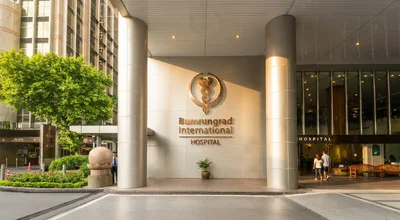
Bumrungrad International Hospital
Full-service hospital with over 1,200 physicians treating 520,000+ international patients a year.
View hospital profile
Bangkok Hospital
BDMS flagship hospital campus with standalone heart, cancer, and neuro-orthopaedic hospitals.
View hospital profile
Samitivej Sukhumvit Hospital
Full-service hospital known for paediatrics, home to Thailand's first private children's hospital.
View hospital profile
Tell Us What You Need. We Do the Rest.
Share what you're considering and we'll come back with surgeon options, pricing, and a clear plan.
- Real hospital pricing with zero markup
- Matched with a specialist experienced in your specific procedure
- Full coordination from consultation to recovery


Trusted by patients worldwide
The complete guide to Hair Transplant in Thailand
Everything below is for readers who want the full detail: costs broken down, types and techniques, recovery, risks and safety, and planning your trip.
Hair Transplant Surgeons & Clinics in Thailand
The surgeon you choose and where they operate matters more than any other variable. Here is what to look for.
Leading Hospitals in Bangkok
Our partner hospitals are JCI-accredited facilities with dedicated hair restoration departments, not side offerings bolted onto a general cosmetic clinic. They have the stereoscopic magnification equipment, climate-controlled graft storage, and surgical teams trained to handle 4,000+ graft sessions efficiently. These are full-scale hospitals that can manage any complication in-house.
Experienced Hair Transplant Surgeons
Our partner surgeons are board-certified and several have completed international fellowships in hair restoration specifically. What sets Thailand apart is the volume; surgeons here perform more hair transplants per year than most Western counterparts simply because the demand from medical tourists is higher. Surgeons with high annual graft volumes tend to achieve more natural-looking hairlines and better graft survival rates.
What to Look for in a Surgeon
Ask to see before-and-after photos of hairline feminisation or masculinisation cases specifically, not just general hair transplant results. Check board certification through the Thai Medical Council. Read reviews on independent platforms. Pay attention to how the surgeon communicates during your consultation. If they promise unrealistic density or dismiss your goals, find someone else.
Understanding Your Results
Hair transplant results are permanent, but they take time to appear. Here is what a realistic timeline looks like and what you should expect at each stage.
Typical Hair Transplant Results
A well-executed gender-affirming hair transplant produces a permanent change in hairline shape and scalp density. For transfeminine patients, the angular M-shape is replaced with a softer, rounder frame. For transmasculine patients, the hairline gains a more defined, straighter contour. The transplanted hair is your own; it grows, can be cut, coloured, and styled like any other hair on your head.
What Results Can You Expect?
Early growth becomes visible from month 3–4, with meaningful density building between months 6–8. The final result settles at 10–18 months once every transplanted follicle has completed at least one full growth cycle. Achievable density and hairline design are discussed during consultation based on your donor supply and scalp characteristics. Be direct about your expectations; it is better to know upfront if a second session might be needed.
Hair Transplant Cost in Thailand
Average Cost of Hair Transplant
Gender-affirming hair transplant in Thailand typically costs between $2,000 and $4,500, depending on the number of grafts, technique, and surgeon. A smaller hairline feminisation case at the lower end of the graft range sits toward $2,000, while larger sessions covering both the hairline and crown, or extensive single-session FUT work, move toward $4,500. Quotes should itemise graft count, technique, and all facility fees so you can see exactly what you are paying for.
Cost Breakdown
The total price is built from several components. The surgeon's fee covers the transplant design, extraction, and placement, the most skill-intensive part. Facility fees cover the operating environment, equipment, and nursing support. Anaesthesia fees cover sedation and monitoring throughout what can be a 4–8 hour procedure. Aftercare includes follow-up visits, graft checks, and any medications needed during your recovery in Thailand.
What Affects the Price?
Graft count is the single biggest price driver. A 1,500-graft hairline case takes half the time of a 4,000-graft session covering the hairline and crown. FUE generally costs more than FUT per graft because the extraction process is slower and more labour-intensive. Sapphire FUE adds a small premium for the precision blades. Surgeon experience and hospital accreditation level also affect the number.
Thailand vs International Price Comparison
Hair transplant in Thailand costs 40–60% less than equivalent procedures in the US ($6,000–$11,000), Australia (A$5,600–A$10,000), and UK (£5,000–£9,000). The price difference reflects Thailand's lower facility and staffing costs, not a difference in surgical standards. Our partner clinics use the same micro-punch instruments, stereoscopic magnification, and graft storage protocols as leading international centres.
Surgical vs Non-Surgical Hair Restoration
Before surgery, many people try medical therapy. Finasteride slows the hormonal process behind hair loss, and minoxidil can thicken and prolong the hairs you still have. Used together and started early, they are genuinely effective at holding on to existing hair, and for gender-affirming patients, oestrogen or anti-androgen therapy often does a similar job. Low-level laser caps and PRP injections are sometimes added on top.
The honest limit is that these treatments maintain and modestly improve what is still there; they do not regrow hair where the follicles are already gone, and they cannot reshape or lower a hairline. They also have to be continued indefinitely, since any gains fade within months of stopping. That makes them a strong first step for early or diffuse thinning, but not a way to rebuild a receded frontal line or fill a bare area.
A hair transplant is the route when the loss is established, when you want to change the shape of the hairline itself, or when you want a permanent result that does not depend on staying on medication for life. The two approaches often work together: many surgeons recommend continuing finasteride or minoxidil after a transplant to protect the surrounding non-transplanted hair, and that is something to discuss at your consultation rather than something we arrange.
Types of Gender-Affirming Hair Transplant
The technique your surgeon recommends depends on how many grafts you need, your hair type, and how you wear your hair. Both approaches produce excellent results; the differences are mainly about scarring and session capacity.
Hairline Feminisation Transplant
Targets the frontal hairline and temporal points specifically. The surgeon designs a rounder, lower hairline that removes the angular peaks associated with male-pattern recession. Usually 1,500–3,000 grafts, placed at precise angles to mimic natural growth direction.
- Lowers and rounds the frontal hairline to create a feminine oval frame
- Fills temporal recessions that hormones alone cannot reverse
- Graft angles follow natural growth patterns for an undetectable result
- Best for: transfeminine patients with temporal recession or a high, angular hairline
Crown and Scalp Density Restoration
Addresses diffuse thinning across the top of the scalp rather than just the hairline. May require 3,000–5,000 grafts depending on the area involved. Often relevant for patients whose hormonal history has left broader thinning that undermines overall hair volume.
- Covers larger areas of diffuse thinning behind the hairline
- Higher graft counts per session, often requiring a full-day procedure
- Can be combined with hairline work in a single session if donor supply allows
- Best for: patients with widespread thinning across the crown or mid-scalp
Hair Transplant Techniques
Two primary extraction methods exist, and the right one depends on your donor density, the number of grafts needed, and whether visible scarring matters to you.
Follicular Unit Extraction (FUE)
Individual follicular units of 1–4 hairs are extracted one by one using a micro-punch (0.6–1.0 mm). No linear scar; just tiny dot marks that are invisible even with short hair. Slower per graft than FUT, but preferred by most gender-affirming patients because of the scarring advantage.
- No linear scar; dot-sized marks are virtually invisible at any hair length
- Donor area heals faster with less post-operative discomfort
- Can harvest from beard or body hair if scalp donor supply is limited
- Best for: patients who wear hair short or want minimal visible scarring
Follicular Unit Transplantation (FUT / Strip Method)
A thin strip of hair-bearing skin is removed from the donor area and dissected into individual grafts under magnification. Allows more grafts in a single session than FUE, but leaves a fine linear scar hidden under surrounding hair. Higher graft survival rate because follicles are less likely to be damaged during extraction.
- Harvests a large number of grafts in one session, ideal for extensive coverage
- Higher graft survival rate compared to FUE in most published studies
- Linear scar is concealed by overlying hair at standard lengths
- Best for: patients needing maximum density who keep hair at medium length or longer
Sapphire FUE
A refinement of standard FUE using sapphire-tipped blades to create recipient micro-incisions. The harder blade material allows smaller, more precise channels, which proponents say may allow closer graft placement and reduce tissue trauma. Worth knowing: robust head-to-head trials against standard steel-blade FUE are limited, and much of the supporting evidence comes from device makers and clinics rather than independent studies, so treat the density and healing claims as plausible rather than proven. Available at Thailand's leading transplant centres.
- Finer incision channels may allow closer graft placement
- May reduce crusting and speed healing of recipient sites, though comparative evidence is limited
- Same extraction method as standard FUE with improved implantation precision
- Best for: patients prioritising maximum density and faster surface healing
DHI (Direct Hair Implantation)
A variation of FUE where each follicle is loaded into a Choi implanter pen and placed directly into the scalp, so the recipient channel and the graft go in together rather than channels being opened first. This gives the surgeon close control over the angle, depth, and direction of every graft, which helps with dense, natural-looking placement along a hairline. It is slower and tends to cost a little more, and not every centre offers it.
- Grafts implanted directly with a Choi pen, no separate channel-cutting step
- Tight control over angle and direction for a natural frontal hairline
- Grafts spend less time outside the scalp, which can support survival
- Best for: detailed hairline design where placement precision matters most
Hair Transplant Recovery Timeline
Days 1–3
Mild swelling and redness across the recipient area are standard. Tiny crusts form around each transplanted graft. Sleep with your head elevated and avoid touching the grafts directly. With FUE the donor area's dot wounds feel tender but settle quickly. With FUT the linear donor incision is more sensitive: expect tightness and more soreness across the back of the scalp for the first several days, controlled with your prescribed pain relief.
Days 4–10
Crusts begin to shed naturally. Gentle washing is introduced following your surgeon's instructions. Swelling resolves and the recipient area starts to look settled. If you had FUT, your sutures or staples in the donor strip are removed at around day 10, which is one reason FUT patients should plan for the full 7–10 day stay; FUE leaves no stitches to remove. You will attend a follow-up appointment for a graft survival check before flying home.
Weeks 2–6
Months 6–12
New hair growth becomes progressively visible and thickens with each passing month. Most patients see meaningful coverage by month 8, with full thickness established between 10 and 18 months1. The transplanted hair is permanent and continues growing for life.
When Can You Fly After a Hair Transplant?
Most patients can fly home 7–10 days after the procedure, once the follow-up graft check confirms everything is tracking well. Cabin pressure at cruising altitude does not affect transplanted follicles. The main concern is avoiding anything that presses on the recipient area, so skip the neck pillow and keep your seatback reclined where possible. Mild swelling may temporarily increase during the flight but settles within a day of landing.
When Can You Return to Work and Exercise?
Desk work is fine from about day 3–4 if you are comfortable, though many patients prefer to wait until crusts have shed around day 7–10. Light walking is encouraged from day one. Gym workouts, swimming, and anything that raises blood pressure or risks impact to the scalp should wait until at least 3–4 weeks post-procedure. Wearing hats or helmets that press on the grafts should be avoided for 2–3 weeks.
When Will You See Final Results?
The transplanted hairs shed between weeks 2–6, which is a normal and expected part of the cycle. New growth starts at around month 3–4. By month 6–8, you will see meaningful coverage and a clear change in hairline shape. Full density, where each follicle has gone through at least one complete growth cycle, takes 10–18 months. Patience matters here; the result at month 4 is not your final result.
Anaesthesia for a Hair Transplant
A hair transplant is done under local anaesthetic, so you stay awake and comfortable throughout.1,2 Your surgeon numbs the donor area at the back and sides of your scalp, and then the recipient zone along the hairline, so the whole working area is fully numb before any grafts are touched. You are not asleep, which is part of why this is a day case rather than an overnight stay, and a nurse and the surgical team monitor you across what can be a 4 to 8 hour session.
Because the procedure is long, most patients are also offered light sedation to help them relax and pass the time, often dozing, reading, or watching something while the team works. That is your choice and the surgeon's call together; the numbing is what keeps you pain-free either way, and full general anaesthesia is not used for this surgery. You will have a pre-operative check of your general health and any medication, including blood thinners or finasteride and minoxidil, so nothing interferes with the day.
The honest version of what it feels like: the only real sensation is the first few numbing injections, which feel like brief pinches or stinging for a minute or two. After that the scalp is completely numb and you feel pressure and movement at most, not pain. Once the anaesthetic wears off that evening, any soreness in the donor area is mild and settles quickly, and it is well controlled with the simple pain relief your surgeon prescribes.
Risks and Safety of Hair Transplant Surgery
Hair transplantation is a well-established microsurgical procedure. Serious complications are uncommon when performed by experienced surgeons in accredited facilities, but you should understand what can go wrong before committing.
- Temporary swelling of the forehead and around the eyes (resolves within a week)
- Mild bleeding or oozing from donor or recipient sites during the first 24 hours
- Temporary numbness in the donor area that typically resolves within weeks
- Infection at donor or recipient sites (rare with proper aftercare)1,2
- Lower-than-expected graft survival resulting in reduced density
- Folliculitis (inflammation of transplanted follicles, usually self-limiting)
- Temporary shock loss (telogen shedding) of surrounding non-transplanted native hair, which usually regrows within 3–6 months
- Overharvesting of the donor zone, which can leave permanent visible thinning at the back and sides if too many grafts are taken in one or repeated sessions
Most patients heal without any complications. The biggest controllable factors are surgeon selection, protecting the grafts during the first two weeks, and following aftercare instructions precisely. Cutting corners on any of those increases your risk unnecessarily.
Is Hair Transplant Surgery Safe in Thailand?
Yes. Thailand's leading hair transplant centres operate within JCI-accredited hospitals using the same sterilisation protocols, equipment, and graft-handling standards as top clinics in Europe or North America. Our partner surgeons hold Thai Board certification and many have trained internationally. The combination of formal credentials and high case volume is what makes the difference.
How to Reduce Risks
Choose a surgeon with specific experience in gender-affirming hairline work, not just general hair transplantation. Verify the facility holds JCI or equivalent accreditation. Follow the post-operative graft protection protocol exactly: no touching, no hats or helmets pressing on grafts for 2–3 weeks, and no heavy exercise for at least two weeks. If you are on finasteride or minoxidil, discuss timing with your surgeon beforehand so nothing interferes with graft survival.
When Is a Second Session Needed?
Some patients need a second session if the area being covered is large and donor supply limits how many grafts can be placed in one sitting. This is not a complication; it is standard practice for cases requiring more than about 4,000 grafts. Whether one session is enough is determined during your consultation. If a second session is needed, it is typically scheduled 8–12 months later once the first round has fully grown in.
Planning Your Trip to Thailand for a Hair Transplant
Most patients need 7–10 days in Thailand. Here is how to structure your trip, what is included, and what to arrange on your own.
How Long to Stay in Thailand
Plan for 7–10 days minimum. Day 1 covers your in-person consultation, donor assessment, and hairline design. The procedure itself takes 4–8 hours depending on graft count. The remaining days cover initial recovery, graft protection, and your follow-up appointment where the surgeon checks graft survival before clearing you to fly home.
What's Included in a Medical Trip
Your care coordinator handles hospital transfers, surgery scheduling, and all follow-up appointments. The surgical quote covers surgeon fees, anaesthesia, facility costs, and aftercare. Flights and accommodation are arranged separately, though your coordinator can recommend nearby hotels that other patients have used during recovery. Everything stays close to the hospital for convenience.
Recovery in Bangkok vs Phuket
Bangkok is the practical choice. You are close to the hospital for follow-ups and if anything unexpected comes up, you are minutes from your surgical team. Some patients relocate to a beach destination after their graft check, but the first 7 days should be spent near the clinic. The recipient area needs protection from sun, wind, and salt water during early healing; a beach is not the ideal environment until grafts are secure.
Related Procedures
Other procedures that address similar goals or conditions, in case one of them is a closer fit for you.
Planning your treatment in Thailand
Independent guides to help you weigh the decision, before you commit to anything.
Common Questions About Hair Transplant
Everything you need to know before your procedure

Medical References
Keep researching with AI
Open this guide in your AI assistant to dig deeper and ask the questions it didn't answer.
Opens in a new tab with this guide already loaded.
Medical disclaimer: Content on this site is provided for informational purposes and should not be treated as medical advice. Outcomes, timelines, and eligibility differ from person to person. Consult a qualified medical professional before making any decisions about surgery or treatment.
Ready to Get Started?
Speak with our care coordinators for a free, no-obligation consultation and personalised quote.
Get a Free Quote