Liver Surgery in Thailand Your guide to cost, top specialists & hospitals
The liver regenerates. A good surgeon knows exactly how much to take and how much to leave.
What Is Liver Surgery?
Also known as: Liver Operation · Hepatic Resection · Hepatectomy
Liver surgery is an operation that removes diseased liver tissue by cutting out a wedge, one or more segments, or a whole lobe. Surgeons call it hepatic resection or hepatectomy. It treats primary liver cancers, bowel cancer that has spread to the liver, and some benign tumours or large cysts. The liver is the only solid organ that regrows, so a healthy remnant gradually grows back towards its original volume, often within weeks though full regrowth can take several months2,3, which is what makes resection safe.
How much is taken depends on where the disease sits and how much healthy liver is left behind. A CT scan measures the future remnant precisely, and a team of specialists reviews your case first. Your surgeon plans around your scans, not a fixed template.
This is major surgery, and how much it achieves depends on your diagnosis. For many people resection clears the disease with healthy margins and offers the best chance of a cure, though outcomes vary and your team will be honest about your case. A consultation, with your imaging reviewed, is the clearest way to know whether resection is right for you.
It can address a range of concerns, including:
Am I a Good Candidate for Liver Surgery?
Candidacy for hepatic resection comes down to one calculation: whether the liver left behind is large enough and healthy enough.
Feasibility is determined by the volume and quality of the liver that remains after resection.
CT volumetry: Pre-operative volumetry calculates the future remnant precisely; adequate volume and function is the central candidate test.
Borderline remnants: Where the remnant looks marginal, portal vein embolisation can grow it before surgery rather than ruling you out.
Localised disease: The lesion must be confined to a resectable part of the liver on imaging, whether that means a wedge, segments, or a full lobe.
A diseased liver regenerates differently, so its baseline condition changes what can safely be removed.
Cirrhosis or fibrosis: Significant underlying disease means resection volume needs hepatology input before any plan is agreed.
Regeneration potential: A healthy remnant gradually regrows towards near-normal volume, often within weeks though full regrowth can take several months, which is what makes partial resection curative.
Smoking stopped: Smoking impairs liver regeneration, so candidates stop at least four weeks before surgery.
Specialists confirm disease extent and treatment sequence before any operating date is offered.
Full staging: Possible extrahepatic disease must be ruled out with PET or MRI before resection is worthwhile.
Chemotherapy interval: Patients mid-chemotherapy need the safe gap between treatment and surgery confirmed with their oncologist.
Tumour board review: Every case goes through multidisciplinary review before surgery, so the operation is one step in a coherent plan rather than an isolated decision.
This is major abdominal surgery, and candidates need to plan for the scale of it.
14-21 days in Thailand: Five to seven nights in hospital, then outpatient blood work and imaging before clearance to fly.
Months of fatigue: Tiredness is the most common complaint after major resection; most people are back to normal routines by eight to twelve weeks.
Pathology guides next steps: Margin status and staging determine whether adjuvant chemotherapy or surveillance follows.
Who is not suitable for liver surgery?
- Possible extrahepatic disease until fully staged with PET or MRI
- Borderline future liver remnant until portal vein embolisation is considered
- Cirrhosis or significant fibrosis without hepatology input on safe resection volume
- Clinically significant portal hypertension (hepatic venous pressure gradient above 10 mmHg)
- Mid-chemotherapy until the safe interval to surgery is confirmed
- Smoking within four weeks of surgery
Pricing
How Much Will Liver Surgery Cost in Thailand?
What liver surgery costs at accredited hospitals in Thailand, and what your final quote depends on.
Get your exact price
Tell us what you're considering and we'll send a personalised quote from accredited hospitals within 24 hours.
Get my free quoteTypical prices in Thailand
Typical ranges based on recent hospital quotes. Your exact price depends on the hospital and how complex your case is, and is confirmed at your teleconsultation.
Liver Surgery
A wedge, one or more segments, or a whole lobe of diseased liver is cut away, and the healthy part that remains gradually regrows.
| Laparoscopic hepatectomy 5 nights Keyhole resection through small incisions with ultrasound guidance | $33,500 ฿1,138,000 |
| Robot-assisted hepatectomy 5 nights The same resection carried out through a surgical console | $34,500 ฿1,173,000 |
Typically not included
- Intensive care and high-dependency time, which most patients need for the first days, and any night beyond the five the package covers
- Portal vein embolisation, where it is needed to grow the remnant before surgery
- Laboratory tests and other investigations, including the CT volumetry the operation is planned from
- Pathology and pathologist charges, including the margin assessment your staging depends on
- Pre-operative medical clearance and fitness assessment
- Open hepatectomy, which is not on the package list and is quoted separately, for large or centrally placed lesions needing open access
Get your exact price
Tell us what you're considering and we'll send a personalised quote from accredited hospitals within 24 hours.
Hospitals Trusted for Liver Surgery
From internationally accredited flagships to dedicated specialist hospitals, these are the kinds of facilities where international patients have this procedure.
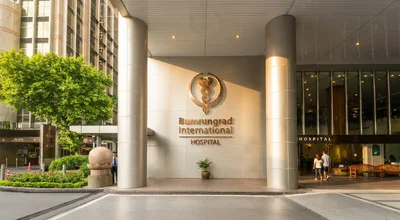
Bumrungrad International Hospital
Tertiary hospital with over 1,200 physicians treating 520,000+ international patients a year.
View hospital profile
Bangkok Hospital
BDMS flagship tertiary campus with standalone heart, cancer, and neuro-orthopaedic hospitals.
View hospital profile
Samitivej Sukhumvit Hospital
Tertiary hospital known for paediatrics, home to Thailand's first private children's hospital.
View hospital profile
Tell Us What You Need. We Do the Rest.
Share what you're considering and we'll come back with surgeon options, pricing, and a clear plan.
- Real hospital pricing with zero markup
- Matched with a specialist experienced in your specific procedure
- Full coordination from consultation to recovery


Trusted by patients worldwide
The complete guide to Liver Surgery in Thailand
Everything below is for readers who want the full detail: costs broken down, types and techniques, recovery, risks and safety, and planning your trip.
Liver Surgeons & Hospitals in Thailand
Liver surgery is one of the most subspecialised areas in general surgery. The surgeon's hepatobiliary training and case volume are the most important variables.
Leading Hospitals in Bangkok
Our partner hospitals have dedicated hepatobiliary departments with fellowship-trained surgeons, in-house ICU, interventional radiology, and on-site pathology. They handle the full spectrum of liver resection, from minor wedge excisions to complex major hepatectomies with vascular reconstruction, and manage complications without external referral.
Experienced Hepatobiliary Surgeons
Our partner surgeons hold subspecialty hepatobiliary training with board certification from the Royal College of Surgeons of Thailand. Many have completed international fellowships at major liver centres in Japan, South Korea, or Europe, bringing back techniques refined through high-volume practice.
What to Look for in a Surgeon
Subspecialty hepatobiliary fellowship training is essential; this is not a procedure for generalists. Ask about the surgeon's major hepatectomy volume and post-operative mortality data. A surgeon who performs CT volumetric assessment and presents every case at a tumour board is following the standard of care for liver surgery.
Understanding Your Results
Liver surgery outcomes are measured by disease clearance, margin status, and long-term survival rather than visible physical change.
Typical Liver Surgery Results
Complete resection with clear margins is the primary goal. The liver regenerates to near-normal volume within weeks. For colorectal liver metastases, around 45% of people are alive five years after surgery4, a significant improvement over systemic chemotherapy alone. Benign lesion removal provides permanent symptom resolution.
What Results Can You Expect?
Pathology confirms margin status and guides further treatment. Liver function normalises as the remnant regenerates. Fatigue resolves gradually over months. For oncological patients, the long-term outlook depends on tumour biology, margin status, and whether recurrence develops, all tracked through structured surveillance imaging.
Liver Surgery Cost in Thailand
Average Cost of Liver Surgery
Our partner hospital quotes ฿1,138,000 for a laparoscopic hepatectomy and ฿1,173,000 for the robot-assisted version, roughly $33,470 and $34,500 at 34 baht to the dollar. Both include five nights on the ward and hold until 31 December 2026. Neither is graded by how much liver comes out, so a wedge and a lobectomy carry the same price as long as the approach is keyhole. Open hepatectomy is not on the list. These are one hospital's fly-in rates rather than an average for Thailand.
Cost Breakdown
The package covers the hepatobiliary surgeon's fee, the operating theatre, the anaesthetist and monitoring through a long operation with significant blood loss risk, and five nights of ward care. Three things sit outside it and all three are likely to apply. The first is high-dependency or intensive care, which most patients need for the first days after a liver resection and which is charged beyond the ward nights in the package. The second is the pre-operative imaging, particularly the CT volumetry the whole operation is planned from. The third is pathology, which for a cancer case sets your margin status and drives what happens next. Budget for all three rather than treating the package as the bill.
What Affects the Price?
The published price barely moves, and that is the surprise. Going robotic adds ฿35,000 over the keyhole route, about 3%, and the extent of the resection does not change the package at all. What genuinely moves your total is everything the package leaves out. Days in intensive care are the largest of those, and a major resection typically needs more of them than a minor one, which is how resection extent reaches your bill by a different route. Imaging, volumetry, portal vein embolisation where the remnant needs growing first, and pathology all add on top. If your lesion needs open access rather than keyhole, the operation falls off the rate card entirely.
Thailand vs International Price Comparison
At $33,470 to $34,500 the packages sit in the middle of the US range of $24,000 to $48,000, well above its floor, and mid-range against the UK figure of £17,600 to £36,000 once converted. Liver resection is long, technically demanding surgery that needs a hepatobiliary unit, intensive care and on-site pathology behind it, and that infrastructure is expensive wherever it sits. This is the premium end of the Thai private market priced for patients who fly in, and prices for the same operation vary substantially between hospitals here, including between branches of one network. What the figure buys is a fellowship-trained hepatobiliary team, tumour board review before a date is set, and no wait.
Types of Liver Surgery
The type of resection depends on tumour location within the liver segments, the number of lesions, and how much healthy liver needs to be preserved. Here are the main categories.
Minor Hepatectomy (Wedge / Segmentectomy)
Removal of a small wedge of tissue or one to two liver segments. Used for smaller, peripherally located tumours where a larger resection is unnecessary. Shorter operative time, lower blood loss, and faster recovery than major hepatectomy.
- Targets small or peripheral tumours with minimal liver volume loss
- Shorter hospital stay and faster recovery
- Often performed laparoscopically in suitable cases
- Best for: small hepatocellular carcinomas, isolated metastases, or benign lesions
Major Hepatectomy (Lobectomy / Extended Resection)
Removal of an entire lobe or extended resection involving four or more segments. Required for large tumours, centrally located lesions, or multiple tumours within one lobe. Pre-operative portal vein embolisation may be needed to increase remnant volume before surgery.
- Removes large or centrally placed tumours with adequate margins
- Portal vein embolisation may grow the remnant before surgery
- Requires careful volumetric planning and multidisciplinary review
- Best for: large hepatocellular carcinoma, multiple metastases within one lobe, or hilar cholangiocarcinoma
Colorectal Liver Metastasis Resection
A specific indication that represents a large proportion of liver surgery worldwide. Resection of colorectal metastases confined to the liver is potentially curative, with around 45% of people alive five years after surgery4. Staged resections and combination with ablation extend the pool of operable cases.
- Potentially curative for liver-confined colorectal metastases
- Can be combined with ablation for bilobar disease
- Staged resections possible for initially unresectable cases
- Best for: patients with colorectal cancer metastatic to the liver without extrahepatic spread
Liver Surgery Techniques
Technique depends on tumour size, location, and the balance between disease clearance and remnant preservation. Here is what is commonly used at our partner hospitals.
Open Hepatectomy
The standard approach for major liver resections, providing direct access to the hepatic vasculature and biliary anatomy. It remains the default for large or centrally located tumours where vascular control is critical. Experienced hepatobiliary surgeons achieve low blood loss through controlled parenchymal transection techniques.
- Full access for complex vascular and biliary anatomy
- Well suited to large or multiple lesions requiring wide exposure
- Established technique with the most extensive long-term outcome data
- Best for: major hepatectomies, centrally located tumours, and cases involving vascular reconstruction
Laparoscopic Liver Resection
Minimally invasive resection through small incisions using specialised instruments and ultrasound guidance. Selected patients benefit from reduced blood loss, less pain, and a shorter hospital stay without compromising oncological margins. Best suited to peripheral tumours in accessible segments.
- Smaller incisions with less post-operative pain and faster mobilisation
- Reduced blood loss and shorter hospital stay in selected cases
- Oncological outcomes equivalent to open resection for appropriate tumours
- Best for: peripheral lesions in anterolateral liver segments
Robotic-Assisted Hepatectomy
The surgeon operates through a console with articulated instruments and magnified 3D vision. The enhanced dexterity is particularly useful for resections in difficult-to-reach posterior segments or when precise dissection around the hepatic veins and portal structures is required. Available at Thailand's leading hepatobiliary centres.
- Superior instrument articulation for posterior segment access
- Magnified 3D vision for precise dissection near critical structures
- Reduced blood loss with potential for shorter hospital stay
- Best for: posterosuperior segment tumours and anatomically challenging resections
Liver Surgery Recovery Timeline
Days 1–3
You are monitored in a high-dependency or intensive care setting with close attention to liver function, drain output, and pain control. Gentle mobilisation begins within 24 hours. Diet progresses from clear fluids to soft foods over the first two to three days as your bowel function returns. Blood tests track liver regeneration from the start.
Days 4–7
You transfer to the surgical ward. Walking distance increases daily with physiotherapy support. Drains are removed once output is minimal. Most patients are back on a normal diet before discharge. Liver function tests are repeated to confirm the remnant is regenerating. Most patients are discharged by day five to seven.
Weeks 2–3
You remain in Bangkok for outpatient follow-up including blood work and imaging to monitor regeneration. Once liver function tests are stable, wound healing is established, and drains are out, you are cleared to fly home, usually two to three weeks after surgery. Light daily activities are manageable, but heavy lifting and strenuous exercise are off limits.
Weeks 3–6
Recovery continues at home, with your blood results and any scans reviewed remotely by your hepatobiliary team. Fatigue is normal and improves progressively week by week. Driving can usually resume once you are off strong painkillers and can brace and perform an emergency stop without pain, around three to four weeks after a laparoscopic or robotic resection and six to eight weeks after an open hepatectomy. Heavy lifting and strenuous exercise remain off limits.
Weeks 6–12
Liver regeneration is typically well advanced. A follow-up scan confirms adequate volume recovery. Most patients return to normal routines by eight to twelve weeks. Ongoing monitoring is arranged through your home physician, with a detailed discharge summary provided.
When Can You Fly After Liver Surgery?
Most patients can fly home two to three weeks after surgery, once liver function tests are stable and wound healing is established. A follow-up CT or ultrasound confirms adequate regeneration before clearance. For the flight, we recommend an aisle seat, compression stockings, regular movement, and adequate hydration.
When Can You Return to Work and Exercise?
Desk work is typically manageable at four to six weeks. Light walking starts in hospital. Driving can usually resume once you are off strong painkillers and can perform an emergency stop without pain, around three to four weeks after a laparoscopic or robotic resection and six to eight weeks after an open hepatectomy. Heavy lifting and strenuous exercise should wait eight to twelve weeks to allow full abdominal wall healing. Fatigue (the most common post-operative complaint) improves progressively but can take several months to fully resolve after major resection.
When Will You See Final Results?
Liver regeneration is usually well advanced by six to eight weeks, with a follow-up scan confirming adequate volume recovery. For cancer patients, the critical result is the pathology report (available within a week) which determines margin status, staging, and whether adjuvant therapy is needed.
Anaesthesia for Liver Surgery
Liver resection is performed under general anaesthesia, so you are fully asleep and aware of nothing during the operation. A consultant anaesthetist stays with you for the whole procedure, monitoring your breathing, circulation, and blood loss closely, which matters more here than in most surgery because the liver has such a rich blood supply. This is standard at the hepatobiliary units we work with, where the anaesthetist is part of the same team that reviews your case beforehand.
There is no awake or sedation-only option for an operation of this scale; major abdominal surgery requires full general anaesthesia. What the anaesthetist does decide, alongside your surgeon, is how your pain is managed once the surgery is done. Most patients are started on an epidural or a patient-controlled analgesia pump in the first days, then moved to oral medication as they improve, with the plan tailored to whether your resection is open, laparoscopic, or robotic.
Before you are cleared, you have a thorough pre-operative assessment, including a liver function panel, coagulation studies, and a cardiac check, so the team is confident you are fit for both the anaesthetic and the surgery itself. You feel nothing during the procedure. Afterwards most people describe moderate discomfort rather than severe pain, with open incisions tending to be more sore than keyhole approaches, and it is well controlled by the medication your team prescribes.
Risks and Safety of Liver Surgery
Liver resection is major surgery. Complication rates have fallen significantly at high-volume hepatobiliary centres, but the risks are real and should be understood clearly.
- Wound infection or intra-abdominal abscess
- Blood clots requiring prophylactic anticoagulation
- Adjacent organ injury during complex resections (uncommon)
The most important risk-reduction step happens before surgery. Accurate volumetric assessment ensures the remaining liver is large enough and healthy enough to sustain function. Every case at our partner hospitals goes through multidisciplinary review before an operating date is set.
Is Liver Surgery Safe in Thailand?
Yes, when performed at a JCI-accredited hospital by a fellowship-trained hepatobiliary surgeon. Thailand's leading hepatobiliary centres achieve outcomes consistent with published international data. Pre-operative CT volumetry, multidisciplinary tumour board review, and dedicated ICU facilities ensure each case receives the infrastructure it requires.
How to Reduce Your Risk
Choose a hospital with a dedicated hepatobiliary unit, not a general surgery department handling occasional liver cases. Verify your surgeon's subspecialty hepatobiliary training and ask about their case volume. Provide complete medical records including all imaging, pathology, and chemotherapy history. If you have underlying liver disease, pre-operative assessment of liver function is critical to determining safe resection volume.
When Is Further Treatment Needed?
Adjuvant chemotherapy may be recommended after resection of colorectal liver metastases, depending on the primary tumour staging and response to pre-operative treatment. For hepatocellular carcinoma, surveillance imaging detects recurrence early. Recurrence rates vary by tumour characteristics, and your oncologist will set the monitoring schedule based on your pathology.
Planning Your Trip to Thailand for Liver Surgery
Most patients need 14–21 days in Thailand for liver surgery. Here is how to plan the trip effectively.
How Long to Stay in Thailand
Plan for 14–21 days minimum. The first two to three days cover consultation, imaging review, and multidisciplinary tumour board discussion. Surgery follows promptly. Hospital stay is five to seven days, with outpatient follow-up for blood work and imaging before clearance to fly.
What's Included in a Medical Trip
Your care coordinator arranges surgery scheduling, hospital transfers, and all follow-up appointments. The published package covers surgeon fees, anaesthesia, theatre and five nights on the ward. Intensive care, pre-operative imaging including CT volumetry, and pathology are charged separately, and since most liver patients need the first of those we set the likely figures out for you in writing before you commit. Flights and accommodation are booked separately, but your coordinator can recommend nearby options.
Recovery in Bangkok vs Phuket
Bangkok is the only sensible base for liver surgery recovery. You need to be close to your hepatobiliary team for blood tests, imaging follow-up, and any drain management. Major abdominal surgery requires proximity to the hospital, and any post-operative concern should be assessed without a flight in between.
Related Procedures
Other procedures that address similar goals or conditions, in case one of them is a closer fit for you.
Planning your treatment in Thailand
Independent guides to help you weigh the decision, before you commit to anything.
Common Questions About Liver Surgery
Everything you need to know before your procedure

Medical References
Keep researching with AI
Open this guide in your AI assistant to dig deeper and ask the questions it didn't answer.
Opens in a new tab with this guide already loaded.
Medical disclaimer: Content on this site is provided for informational purposes and should not be treated as medical advice. Outcomes, timelines, and eligibility differ from person to person. Consult a qualified medical professional before making any decisions about surgery or treatment.
Ready to Get Started?
Speak with our care coordinators for a free, no-obligation consultation and personalised quote.
Speak to Our Team