Haemorrhoid Surgery in Thailand Your guide to cost, top specialists & hospitals
A problem that most people tolerate for years can be resolved in under an hour.
What Is Haemorrhoid Surgery?
Also known as: Piles Surgery · Haemorrhoidectomy · Haemorrhoidal Procedures
Haemorrhoid surgery is a procedure that treats enlarged, symptomatic haemorrhoids by removing or shrinking the swollen vascular cushions in the anal canal, stopping the bleeding, prolapse, itching, and discomfort they cause. Depending on the technique, the tissue is cut away, lifted back into place with a stapler, or shrunk by closing off its blood supply. It usually takes 30 to 60 minutes under general anaesthesia, as a day case or one night in hospital, and is normally reserved for grade III and IV haemorrhoids, or lower grades that banding, sclerotherapy, or diet have not settled.
This is a private problem many people tolerate far longer than they need to, and there is nothing unusual about you for being here. Your surgeon examines you first, then matches the technique to the grade and pattern of your haemorrhoids.
Be realistic about recovery. Most people see their symptoms resolve, but the first few bowel movements are the uncomfortable part, eased by sitz baths, pain relief, and stool softeners. The techniques balance pain against recurrence differently, which is what your consultation is for.
It can address a range of concerns, including:
Am I a Good Candidate for Haemorrhoid Surgery?
Surgery is for graded, properly investigated haemorrhoidal disease that has outlasted banding, dietary change, and patience.
The grade of disease determines whether surgery is appropriate at all.
Grade III or IV: Internal haemorrhoids at these grades, confirmed on examination, are the standard surgical indication.
Lower grades after failure: Grade II disease qualifies only when banding, sclerotherapy, and dietary measures have already failed.
Pattern steers technique: Number, position, and previous treatments decide between open excision, stapled haemorrhoidopexy, artery ligation, or laser.
Rectal bleeding is never assumed to be haemorrhoids, even when haemorrhoids are present.
Bleeding investigated: Proctoscopy or flexible sigmoidoscopy excludes other pathology before any haemorrhoid procedure is booked.
Bowel disease reviewed: Inflammatory bowel disease significantly alters which techniques are safe, so it is screened for.
Standard workup: Full blood count, coagulation studies, and thorough anorectal examination complete the picture.
Sphincter function shapes which techniques the surgeon will even consider.
Pre-existing continence change: Any existing weakness makes excisional and aggressive approaches riskier, and the plan adjusts accordingly.
Tissue-sparing options: Artery ligation and stapled techniques avoid cutting in the sensitive perianal skin, suiting patients where caution is needed.
Medication planning: Anticoagulants and antiplatelets need a pause window agreed with the prescriber before surgery.
The result is excellent; the recovery, particularly early bowel movements, is the part to prepare for.
Recovery is the hard part: The first few bowel movements are the most uncomfortable stage, managed with sitz baths, analgesics, and stool softeners.
Pain versus recurrence: Open excision has the lowest recurrence but the most painful recovery; stapled and ligation techniques are gentler with higher recurrence.
Lasting symptom resolution: By four to six weeks most patients describe themselves as completely symptom-free.
Who is not suitable for haemorrhoid surgery?
- Rectal bleeding not yet investigated with proctoscopy or sigmoidoscopy
- Inflammatory bowel disease until technique safety is reviewed
- Pre-existing change in continence until a sphincter-sparing plan is agreed
- Anticoagulants or antiplatelets without an agreed pause window
- Pregnancy, where elective haemorrhoid surgery is deferred until after delivery
- Active Crohn's or perianal Crohn's disease, where excisional haemorrhoidectomy is not advised
Pricing
How Much Will Haemorrhoid Surgery Cost in Thailand?
What haemorrhoid surgery costs at accredited hospitals in Thailand, and what your final quote depends on.
Get your exact price
Tell us what you're considering and we'll send a personalised quote from accredited hospitals within 24 hours.
Get my free quoteTypical prices in Thailand
Typical ranges based on recent hospital quotes. Your exact price depends on the hospital and how complex your case is, and is confirmed at your teleconsultation.
Haemorrhoid Surgery
Swollen vascular cushions in the anal canal are cut away or shrunk to stop the bleeding, prolapse and discomfort that enlarged haemorrhoids cause.
| Haemorrhoidectomy, day surgery Day case Excisional removal, the technique with the lowest recurrence | $3,150 ฿107,000 |
| Haemorrhoidectomy, open 1 night The open excisional technique, with a night on the ward built into the package | $4,050 ฿138,000 |
| Laser haemorrhoidectomy, same day surgery Day case A laser fibre shrinks the tissue from within, with less early pain | $4,400 ฿149,000 |
| Laser haemorrhoidectomy, one night 1 night The laser route with a planned night on the ward | $4,750 ฿161,000 |
Typically not included
- Stapled haemorrhoidopexy and artery ligation are quoted separately, as they sit outside these four packages
- Any night in hospital beyond what the package you choose covers
- The proctoscopy or flexible sigmoidoscopy that should investigate your bleeding before surgery is booked
- Pre-operative medical clearance and fitness assessment
- Laboratory tests and other investigations
- Pathology and pathologist charges on any tissue removed
Get your exact price
Tell us what you're considering and we'll send a personalised quote from accredited hospitals within 24 hours.
Hospitals Trusted for Haemorrhoid Surgery
From internationally accredited flagships to dedicated specialist hospitals, these are the kinds of facilities where international patients have this procedure.
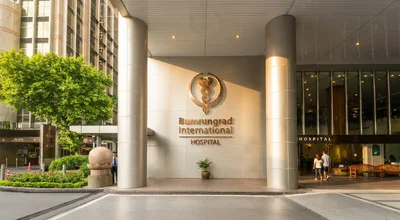
Bumrungrad International Hospital
Tertiary hospital with over 1,200 physicians treating 520,000+ international patients a year.
View hospital profile
Bangkok Hospital
BDMS flagship tertiary campus with standalone heart, cancer, and neuro-orthopaedic hospitals.
View hospital profile
Samitivej Sukhumvit Hospital
Tertiary hospital known for paediatrics, home to Thailand's first private children's hospital.
View hospital profile
Tell Us What You Need. We Do the Rest.
Share what you're considering and we'll come back with surgeon options, pricing, and a clear plan.
- Real hospital pricing with zero markup
- Matched with a specialist experienced in your specific procedure
- Full coordination from consultation to recovery


Trusted by patients worldwide
The complete guide to Haemorrhoid Surgery in Thailand
Everything below is for readers who want the full detail: costs broken down, types and techniques, recovery, risks and safety, and planning your trip.
Haemorrhoid Surgeons & Hospitals in Thailand
For proctological procedures, you want a colorectal surgeon who handles these cases routinely. Here is what to look for.
Leading Hospitals in Bangkok
Our partner hospitals have dedicated colorectal surgery departments with the full range of proctological equipment: stapling devices, Doppler probes, laser platforms, and examination-under-anaesthesia capability. These are full-scale hospitals, not standalone clinics, with in-house capability to manage any complication.
Experienced Colorectal Surgeons
Our partner surgeons are board-certified with specific experience in proctological surgery. They perform haemorrhoidectomy, artery ligation, and stapled procedures as a core part of their practice. High case volume means familiarity with all techniques and the judgment to choose the right one.
What to Look for in a Surgeon
Check that the surgeon is a colorectal specialist, not a general surgeon who does the occasional haemorrhoid case. Ask which techniques they offer and how they decide between them; a surgeon who only offers one approach may not be matching the technique to your disease. Independent patient reviews add confidence.
Understanding Your Results
Haemorrhoid surgery is about symptom resolution: eliminating bleeding, prolapse, and discomfort that conservative measures could not control.
Typical Haemorrhoid Surgery Results
Bleeding stops immediately. Prolapse is eliminated. Pain resolves over the first few weeks as wounds heal. The visible bulging tissue is gone. Long-term, maintaining a high-fibre diet and avoiding straining protects the result and reduces the chance of new haemorrhoids developing.
What Results Can You Expect?
The large majority of patients achieve complete resolution of their primary symptoms. The recovery period, particularly the first few bowel movements, is the most challenging part. By four to six weeks, most patients describe themselves as completely symptom-free and wonder why they waited so long.
Haemorrhoid Surgery Cost in Thailand
Average Cost of Haemorrhoid Surgery
Our partner hospital quotes four packages, running from ฿107,000 for conventional excision as day surgery to ฿161,000 for a laser haemorrhoidectomy with a night on the ward. At 34 baht to the dollar that is roughly $3,147 to $4,736. The prices hold until 31 December 2026 and are one hospital's rates, not an average for Thailand. Stapled haemorrhoidopexy and artery ligation, both discussed further up this page, sit outside those packages and would be quoted separately.
Cost Breakdown
The package covers the surgeon's fee, the operating theatre, the anaesthetist and monitoring, the laser fibre where that route is chosen, and either the day-case facility or the ward night, depending on which package you take. It is not all-inclusive. Pre-operative medical clearance, blood tests, any consultant seen other than the operating surgeon, and pathology on the tissue removed are billed on top. So is the proctoscopy or sigmoidoscopy that should investigate your bleeding before a haemorrhoid operation is booked at all, which is a step worth budgeting for even if you have already had it at home.
What Affects the Price?
Two levers, and the second one is the interesting one for anyone flying in. Laser costs more than conventional excision, ฿42,000 more as day surgery, which buys a gentler first week rather than a better long-term result. The overnight decision is priced separately on each route and the gap is very uneven. The conventional overnight package sits ฿31,000 above the day-surgery one, about 29%, while on the laser route the difference is ฿12,000, about 8%. That matters more than the money suggests. The first day after excisional surgery is the sorest, and getting through it in a hotel room to save ฿31,000 is a different proposition from getting through it on a ward with a nurse and a call button. If you are travelling alone, take the night.
Thailand vs International Price Comparison
At $3,147 to $4,736 these packages undercut the US range of $4,500 to $9,000 at the bottom, but the most expensive of the four lands just above the US floor. Converted, the cheapest package sits about a quarter under the UK floor of £3,300 and the dearest a little above it. So the saving depends entirely on which package you take. It is worth having at the cheaper end and thins to nothing if you choose the laser route with an overnight stay. Our partner hospital sits at the premium end of the Thai market, and prices for the same operation vary widely between Thai hospitals, including between branches of this same network. Access is the stronger argument than price, since public systems deprioritise proctology and waits run long.
Non-Surgical Alternatives to Haemorrhoid Surgery
Most haemorrhoids never need surgery. For early disease, the first steps are conservative: more dietary fibre and fluids to soften stools and stop straining, topical creams to ease symptoms, and a short course of office treatment if those are not enough. Rubber band ligation places a tiny elastic band around the base of an internal haemorrhoid so it shrinks and drops off, and sclerotherapy injects a solution that does much the same by closing off the blood supply. Both are quick, done without anaesthetic, and effective for grade I and II haemorrhoids.
The honest limit is what these office treatments can reach. Banding and injections work on smaller internal haemorrhoids; they do little for large grade III and IV prolapse, external haemorrhoids, or mixed disease, and the haemorrhoids can return, so a course sometimes has to be repeated. Banding can also cause discomfort or minor bleeding, and not every haemorrhoid is suitable. They are a genuine first line, not a guaranteed permanent fix.
Surgery becomes the right step once haemorrhoids are grade III or IV, are prolapsing or external, or have kept coming back despite banding, sclerotherapy, and dietary change. At that point an operation removes or lifts the tissue properly and gives the most durable result, which is what the rest of this page covers. Either way, any rectal bleeding should be investigated first, since bleeding is never simply assumed to be haemorrhoids.
Types of Haemorrhoid Surgery
Each technique addresses haemorrhoids differently. The right choice depends on haemorrhoid grade, number, position, and any previous treatments. Your colorectal surgeon will examine you and recommend the most effective approach.
Open Haemorrhoidectomy (Milligan-Morgan)
The traditional excisional technique. Haemorrhoidal tissue is surgically removed and wounds left open to heal naturally from the base up. It offers the lowest long-term recurrence rate and handles large, complex, or mixed haemorrhoids that other techniques cannot address adequately.
- Lowest recurrence rate of all surgical approaches
- Handles large, multiple, or complex haemorrhoids
- More post-operative pain than non-excisional alternatives
- Best for: grade III–IV haemorrhoids where durability of result matters most
Stapled Haemorrhoidopexy (PPH)
A circular stapling device excises a ring of rectal mucosa above the haemorrhoids, lifting prolapsed tissue back into position and cutting off blood supply. No wounds in the sensitive perianal skin means significantly less pain than open excision. The trade-off is a small set of stapler-specific risks, staple-line bleeding, staple misfire, and rarely rectal wall perforation or pelvic sepsis, which is why technique selection and surgeon experience matter.
- Substantially less post-operative pain than open surgery
- Effective for circumferential prolapsing haemorrhoids
- Higher recurrence rate than excisional techniques4
- Carries rare stapler-specific risks (perforation, staple-line bleeding) not seen with open excision
- Best for: circumferential grade III prolapse where pain minimisation is a priority
Haemorrhoidal Artery Ligation (HAL / DGHAL)
A Doppler probe identifies arteries feeding the haemorrhoidal tissue, which are then ligated with sutures. The haemorrhoids shrink over the following weeks as blood supply is cut. A mucopexy suture lifts any prolapse. No tissue is cut or excised, so post-operative pain is minimal.
- Doppler-guided precision targets feeding arteries specifically
- No tissue excision, minimal post-operative pain
- Suited to grade II–III haemorrhoids with moderate prolapse
- Best for: patients who want minimal pain and acceptable recurrence rates
Haemorrhoid Surgery Techniques
Technique depends on haemorrhoid grade, anatomical pattern, and your tolerance for post-operative discomfort versus long-term recurrence risk. Your surgeon will discuss these trade-offs openly.
Conventional Excision (Milligan-Morgan / Ferguson)
Direct surgical excision of haemorrhoidal tissue with precise dissection to preserve the sphincter. Milligan-Morgan leaves wounds open to heal by secondary intention; Ferguson closes the wounds with sutures. Both achieve the lowest recurrence rates of any technique and remain the benchmark for advanced disease.
- Definitive removal with the lowest long-term recurrence rate
- Precise dissection preserves sphincter integrity
- Recovery is more uncomfortable than non-excisional alternatives
- Best for: large, grade IV, or multi-quadrant haemorrhoids
Laser Haemorrhoidoplasty
A laser fibre is inserted directly into the haemorrhoidal tissue, delivering controlled thermal energy that shrinks the vascular cushion from within. Minimal tissue damage to surrounding structures means less pain and faster recovery. Well suited to grade II–III haemorrhoids.
- Minimally invasive with low post-operative pain
- No open wounds, faster early recovery
- Growing evidence base for mid-grade haemorrhoidal disease
- Best for: grade II–III haemorrhoids where rapid recovery is a priority
LigaSure / Energy-Device Haemorrhoidectomy
An excisional technique that uses a sealing energy device, such as LigaSure bipolar or an ultrasonic instrument, to remove the haemorrhoid while sealing the vessels as it cuts. Sealing the tissue rather than tying or cauterising it reduces bleeding during surgery and tends to mean less pain and a quicker operation than conventional cold-steel excision, with the same definitive removal.
- Seals vessels as it cuts, so very little bleeding during surgery
- Faster operation and usually less pain than conventional excision
- Keeps the durability of an excisional result for advanced disease
- Best for: grade III–IV haemorrhoids where a definitive removal is wanted with a gentler recovery than open cold-steel excision
Combined Approaches
For complex cases, surgeons may combine techniques in a single session, excising dominant haemorrhoids while performing artery ligation or laser treatment on smaller ones. This hybrid strategy maximises disease clearance while minimising wound burden and recovery pain.
- Tailored combination of techniques for complex haemorrhoidal patterns
- Reduces wound burden by treating smaller haemorrhoids non-excisionally
- Balances thoroughness against post-operative comfort
- Best for: mixed haemorrhoidal disease with dominant and minor components
Haemorrhoid Surgery Recovery Timeline
Day 1
You recover from anaesthesia and are monitored for early post-operative bleeding. Pain management with analgesics and stool softeners begins immediately. Most patients eat, drink, and walk within a few hours. Day-case patients may leave the same evening.
Days 2–4
The first few bowel movements are the most uncomfortable part of recovery. Warm sitz baths, prescribed analgesics, and stool softeners make this manageable. You rest at your hotel in Bangkok with light activity, high-fibre diet, and plenty of fluids.
Days 5–7
Pain diminishes noticeably and bowel function normalises. A follow-up appointment confirms wound healing is progressing well. Your surgeon clears you for the return flight and provides written aftercare instructions with a direct contact for the surgical team.
Weeks 2–4
Most patients return to desk work within one to two weeks1. Sitz baths and wound care continue at home. Strenuous exercise, heavy lifting, and prolonged sitting on hard surfaces should wait three to four weeks. Complete healing typically occurs within four to six weeks.
When Can You Fly After Haemorrhoid Surgery?
Most patients can fly home five to seven days after surgery, once wound healing is confirmed. Bring a cushion for the flight if sitting is still uncomfortable. Request an aisle seat so you can stand periodically. Stay hydrated and move regularly during the flight.
When Can You Return to Work and Exercise?
Desk work within one to two weeks for most patients. Physically demanding roles may need three to four weeks. Avoid prolonged sitting on hard surfaces during the first two weeks. You can usually drive again once you are off prescription painkillers and can sit and perform an emergency stop without hesitation, typically around a week after a non-excisional procedure (artery ligation, laser, or stapled) and up to two weeks after open excision. Exercise resumes gradually: walking first, then gym work by week four. Swimming pools should wait until the wounds are fully healed, usually around four to six weeks.
When Will You See Final Results?
Bleeding and prolapse resolve immediately. Post-operative discomfort peaks in the first few days (particularly around bowel movements) and improves steadily. Full wound healing takes four to six weeks depending on the technique. By eight weeks, most patients have forgotten they had the procedure.
Anaesthesia for Haemorrhoid Surgery
Haemorrhoid surgery in Thailand is usually performed under general anaesthesia, so you are fully asleep and feel nothing during the operation. A consultant anaesthetist stays with you throughout and monitors you continuously, which is standard at the accredited hospitals we work with. The operation itself is short, typically 30 to 60 minutes, so your time under anaesthesia is brief.
Some patients are suitable for a spinal anaesthetic instead, which numbs you from the waist down while you stay awake, and your surgeon and anaesthetist decide what is safest based on your health and the technique planned. Either way, you have a pre-operative assessment first, including blood tests, a review of any medications you take, and an agreed pause window for blood thinners, so you are properly cleared before the day of surgery.
You feel nothing while the surgery is carried out. Be reassured that the awkward, private nature of this area is routine for the colorectal team, and you are asleep for all of it. The honest part is afterwards: the wounds themselves settle quickly, but the first few bowel movements are the uncomfortable stage rather than the operation. That discomfort is mild to moderate and well managed with the warm sitz baths, pain relief, and stool softeners your surgeon prescribes.
Risks and Safety of Haemorrhoid Surgery
Haemorrhoidal surgery is well established and low risk. The main concern for most patients is post-operative pain (which varies significantly by technique) rather than serious surgical complications.
- Post-operative bleeding (usually minor but occasionally requires assessment)
- Wound infection (uncommon with proper hygiene and sitz baths)
- Urinary retention (temporary difficulty passing urine after spinal or general anaesthesia)2,3
- Anal stenosis or narrowing of the anal canal (rare, associated with excessive tissue removal)2,1
- Anal fistula (fistula-in-ano), an abnormal tract that can develop as a wound heals, more often after open excision and occasionally needing a further procedure
- Faecal urgency or minor incontinence (uncommon, typically temporary)3,1
- Stapled haemorrhoidopexy (PPH) specific: staple-line bleeding, staple misfire, and rarely rectal wall perforation or pelvic/retroperitoneal sepsis, which is why an experienced colorectal surgeon and a full hospital matter
- Recurrence (rates vary by technique, lowest with open excision)
The most important modifiable factor after surgery is bowel management. Keeping stools soft with adequate fibre and fluid intake prevents straining, reduces wound pain, and protects the surgical result during healing.
Is Haemorrhoid Surgery Safe in Thailand?
Yes. Haemorrhoidal surgery at a JCI-accredited Thai hospital follows the same surgical protocols as any accredited Western facility. Our partner colorectal surgeons are board-certified and perform these procedures routinely. Complication rates are consistent with published international data.
How to Reduce Your Risk
Choose a colorectal surgeon rather than a general surgeon; haemorrhoid surgery is technical work that benefits from proctological expertise. Follow the post-operative bowel management instructions carefully; straining is the enemy of healing. Report any heavy bleeding, fever, or inability to urinate promptly.
When Is Repeat Treatment Needed?
Recurrence depends on technique and lifestyle. Open haemorrhoidectomy has the lowest recurrence rate. If new haemorrhoids develop, maintaining a high-fibre diet, staying hydrated, and avoiding prolonged straining are the first-line measures. Repeat surgical treatment is uncommon when the initial operation is appropriate for the grade of disease.
Planning Your Trip to Thailand for Haemorrhoid Surgery
Most patients need five to seven days in Thailand. The trip is straightforward to plan.
How Long to Stay in Thailand
Five to seven days is sufficient. Day one covers consultation and examination. Surgery is typically on day two. One night in hospital (or same-day discharge), then hotel recovery for three to four days with a follow-up appointment before flying home.
What's Included in a Medical Trip
Your care coordinator arranges the consultation, surgery scheduling, and follow-up. The package covers surgeon fees, anaesthesia, the theatre and either the day-case facility or the ward night, depending on which of the four you take. Pre-operative clearance, blood tests and any endoscopic investigation of your bleeding are billed separately, and we set those out for you before you commit. Flights and accommodation are booked separately. Your coordinator can recommend hotels near the hospital.
Recovery in Bangkok vs Phuket
Stay in Bangkok for the surgical window. Haemorrhoid surgery recovery is short, and you want proximity to the hospital for the follow-up appointment. After clearance, some patients enjoy a few days of relaxation elsewhere before heading home. That is fine once the surgeon has confirmed healing.
Related Procedures
Other procedures that address similar goals or conditions, in case one of them is a closer fit for you.
Planning your treatment in Thailand
Independent guides to help you weigh the decision, before you commit to anything.
Common Questions About Haemorrhoid Surgery
Everything you need to know before your procedure

Medical References
Keep researching with AI
Open this guide in your AI assistant to dig deeper and ask the questions it didn't answer.
Opens in a new tab with this guide already loaded.
Medical disclaimer: Content on this site is provided for informational purposes and should not be treated as medical advice. Outcomes, timelines, and eligibility differ from person to person. Consult a qualified medical professional before making any decisions about surgery or treatment.
Ready to Get Started?
Speak with our care coordinators for a free, no-obligation consultation and personalised quote.
Speak to Our Team